PIXNET Logo登入

小姐你哪位?

跳到主文

歡迎光臨Enzo在痞客邦的小天地

部落格全站分類:不設分類

  • 相簿
  • 部落格
  • 留言
  • 名片
  • 4月 04 週五 201418:26
  • Research Assignment 4: Recipe Development: Part 1

Research Assignment 4: Recipe Development: Part 1


Learning Objective: Develop recipes, production techniques and decorations


Assignment 4: Recipe Development: Part 1


For this assignment, you will develop 2 different bonbons/confections that show your experimentation with the basic recipe techniques.


You will practice ONCE your choice of recipe for 2 different centers:


  1. Ganache with cream in a flavor of your choice.

  2. Either a layered center with one layer ganache and one layer Pate de Fruits or an unlayered center using Fondant in a flavor of your choice


Your next requirement is to finish each bonbon/confection differently using two of the following three ways:


One bonbon/confection would be in the shape of a ball and rolled in some type of coating to protect the surface such as cocoa powder, icing sugar/sugar, chopped nuts, or cookie crumbs, etc.
or
One bonbon/confection would be enrobed and decorated with a placed \ decoration. Either a chocolate decoration that was made separately and then placed on top of the bonbon or an ingredient i.e. a whole nut, candied peel or flower, coffee bean, etc.
or
One bonbon/confection would have a molded shell where you have combined at least two different colors of chocolate or colored cocoa butter, either by painting (using your finger or a brush), marbling, spray painting, or any other decorating technique you want to use to finish the inside of the cavity.

Your report will include the following for each Chocolate:


  • The name and a brief description of the recipe you developed.


Ecole Chocolate Note: we already have recipes for the basic ganache, fondant, croquant, etc. so you don't need to describe those. Just describe your additions to the basics. For example your recipes would be something like this:


Mint Ganache:
A classic dark chocolate ganache was made with cream flavored with a cold emulsion using 4 oz of fresh mint leaves (removed from the cream after overnight in the refrigerator). Ganache is slabbed and stored in a cool room for 24 hours before cutting into squares.


or


Tequila Creme
To a recipe of finished fondant add 1 drop yellow colorant to produce a pale yellow color, 1/4 cup chopped lime zest, 1 drop lime essential oil and two teaspoons white tequila. Spoon into prepared shell molds.


  • What chocolate you used to coat each center and why you chose that particular flavor.

  • The technique you used to coat each center in chocolate (did you roll, enrobe or pipe in a shell mold?). Did you find any challenges with the technique?

  • Describe the decoration you used to finish each bonbon/confection?


In the same report, answer the following questions under a heading of: Lessons Learned.


  • What did you learn about recipe development that surprised you?

  • Did the exercise of creating a whole new bonbon/confection from scratch teach you anything about chocolate?


Note about the Lessons Learned section. We want your observations on recipe development - I've given you some suggested questions to answer but feel free to simply give us your feelings and observations. Take time to think about the processes and results.


Note on your report content: what we are looking for is a concise report on your research or practice coupled with a thoughtful response to our questions. We are grading strictly on content - not how well or how much you write. There is a maximum of 1500 words allowed in the box but we are in no way expecting or want you to fill it.


Optional - Including Images in your assignment submission - Please remember that images are not required nor included in the grading. If you want to share an image then the best thing to do is to attach that image to the copy of the report you are posting in the Chef's Table. Note that the Learning Centre software only allows you to attach one image or document to a posting. If you want to add multiple images you will need to reply to your own posting and add the next image to that.


Click on the "Add Submission" button below to submit your assignment.


When you click on the "Add Submission" button - a text submission box will appear at the bottom of the page. You may have to scroll down to see that. You have a choice of typing your report directly into the box and then clicking the "Save changes" button below it to submit.


OR WE VERY, VERY HIGHLY SUGGEST that you create your assignment report in another editor in your computer and save that.Then copy and paste the text in your saved report into the submission box and click the "Save changes" button to submit. This process makes sure that you have a saved copy of your report in case something happens when you submit.


Confirming your assignment submission and viewing grades:


Once you've submitted your assignment, A message appears that says "Your changes have been saved". Also you will see under the Assignment Due Date a new line that starts with"Last Edited....". That confirms that your assignment has been submitted and when.


Don't forget to be generous and share a copy of this assignment report with your classmates by posting it to the Chef's Table in the appropriate assignment discussion.


We wait until after the Assignment due date (see below) to start grading the assignments - you can expect to see your grade posted within 10 working days after the due date has passed.



(繼續閱讀...)
文章標籤

Enzo1985 發表在 痞客邦 留言(0) 人氣(57)

  • 個人分類:Lesson 1: Technique and Production
▲top
  • 4月 04 週五 201418:26
  • Information: About Module Four

Learning Objective: Understand what is included in this module


Chocolate bonbon technique and production
"My Ideas come from within. Its rare I get an idea from tasting something, but rather from conversations, emotions, reading, meeting. I write my ideas down in diagram form first, then recipes . I have what I call a scenario of taste - I imagine this in a sequence as you bite into the cake - what happens first, what happens second, what may provide a surprise in the middle. And because only taste matters, I avoid embelishments that bring no contributions to the flavors, nor add anything to the combinations." Pierre Herme as told to Food Arts Magazine
(繼續閱讀...)
文章標籤

Enzo1985 發表在 痞客邦 留言(0) 人氣(9)

  • 個人分類:Lesson 1: Technique and Production
▲top
  • 4月 04 週五 201418:24
  • Discussion Assignment 3: Report on Your Chocolate Tasting

Discussion Assignment 3: Report on Your Chocolate Tasting


Learning Objective: Conduct a chocolate tasting and report on the findings.


Discussion Assignment: Report on Your Chocolate Tasting


Expertise derives from taste experience so you will complete this assignment by conducting a formal tasting comparing dark chocolates. On our Supplies page we suggested that you include both grocery store chocolates and couvertures to your tasting. You can add varieties of milk or white chocolate to your tasting as your budget allows but they are not required.


Conduct a Chocolate Tasting


You can do this alone or you can invite other people to the tasting. Having more than one person means that you will have more than one opinion - as Martha would say - A good thing!


As you remember from the Student Supplies list, we suggested you have the following on hand for your tasting assignment:


  • At least 4 - 6 different brands of dark chocolates to taste and compare with each other, including the chocolate you've chosen to work with in chocolate making. A 100 - 250 g ( 4 - 8 oz.) sample of each chocolate will give you enough for a series of tastings.

  • 1 package of Bakers or Nestle Semisweet chocolate squares or another type of baking chocolate found in your supermarket.

  • 1 inexpensive Lindt, Toblar, or Sucard solid semisweet or bittersweet chocolate bar that you find in drug stores, markets or delis.

  • 1 100 - 250 g ( 4 - 8 oz.) sample of semisweet or dark confectioner's coating* chocolate. This is usually available as wafers in kitchen shops.


You will need to develop the guide or rating sheet for your tasters to jot down their impressions of the chocolates during the tasting. I suggest you research the following information from these lectures in this Module to help you:


  • The description of how chocolate tastes as described in the lecture Module 3: Develop Your Tasting Palate.

  • The manufacturers descriptions of the flavor of their products on information page Module 3: Describing the Flavor of Grand Cru.


Report on Your Chocolate Tasting


Report on the results of your chocolate tasting. The following is an very basic example of the results of a Sunset Magazinetasting.


A bittersweet tasting - Sunset, the magazine of Western living


We invited chocolate amateurs and professionals to rate two dozen plain bittersweet and semisweet chocolates in a blind tasting. The professionals were precise about what they liked - rich, balanced overall flavor and a smooth, pleasant meltdown in the mouth. They downgraded chocolates with off-flavors from the beans or flavor defects from processing. The amateurs just went for taste and texture.


Their collective favorites, in alphabetical order:


Belgian Recipe Gourmet Chocolate. Good base chocolate flavor for chips. Nice acidity, along with citrus and honey flavors; smooth.


Callebaut Bittersweet Chocolate. Robust chocolate flavor with vanilla; complex; melts nicely.


Droste Bittersweet Pastilles. Vanilla and slight raspberry or almond flavors; melts nicely.


Lindt Excellence Swiss Bittersweet Chocolate (Criollo beans from Central America). Mild and pleasant, caramel flavor; melts smoothly with just a little graininess.


Michel Cluizel Chocolat Amer Brut. Ends nicely with strong chocolate flavor, bitter edge.


Valrhona. Equatoriale (beans from South America, Africa): basic chocolate flavor with citrus and hints of other fruit, smooth. Le Noir (beans from Trinidad): fruity, winy, spice notes. Le Noir Amer (beans from Venezuela): clean, sharp chocolate flavor on the acidic side, fruity, winy, smooth but waxy at the start. Le Noir Gastronomie (Criollo beans from South America, Forasteros from Africa): good base strength, good vanilla, fruity, winy, smooth; melts nicely.


To complete this assignment, include the following in your report:


  • How many chocolate samples do you feel are appropriate for a chocolate tasting?

  • What size would each sample be?

  • What would you use to deliver and label each sample so your tasters could keep them separate?

  • What information would you include about each samples?

  • On your tasting sheet what would be the main flavor categories that you would be asking people to taste for?

  • How many people took part in the tasting?

  • Which chocolate was the most popular and why?

  • How was this formal tasting received by your tasters? What were their comments?

  • How did this formal tasting increase your knowledge of the products you tasted?


In the same report, answer the following questions under a heading of: Lessons Learned.


  • What do you think about the way the chocolate industry describes the flavor and aroma of the different chocolates?

  • What did this tasting teach you about people and about tasting chocolate?

  • What lessons did you learn about holding a chocolate tasting and would you change in the future?


Note about the Lessons Learned section. We want your observations on your chocolate tasting- I've given you some suggested questions to answer but feel free to simply give us your feelings and observations. Take time to think about the results.


Note on your report content: what we are looking for is a concise report on your research or practice coupled with a thoughtful response to our questions. We are grading strictly on content - not how well or how much you write. There is a maximum of 1500 words allowed in the box but we are in no way expecting or want you to fill it.


Click on the "Add Submission" button below to submit your assignment.


When you click on the "Add Submission" button - a text submission box will appear at the bottom of the page. You may have to scroll down to see that. You have a choice of typing your report directly into the box and then clicking the "Save changes" button below it to submit.


OR WE VERY, VERY HIGHLY SUGGEST that you create your assignment report in another editor in your computer and save that.Then copy and paste the text in your saved report into the submission box and click the "Save changes" button to submit. This process makes sure that you have a saved copy of your report in case something happens when you submit.


Confirming your assignment submission and viewing grades:


Once you've submitted your assignment, A message appears that says "Your changes have been saved". Also you will see under the Assignment Due Date a new line that starts with"Last Edited....". That confirms that your assignment has been submitted and when.


Don't forget to be generous and share a copy of this assignment report with your classmates by posting it to the Chef's Table in the appropriate assignment discussion.


About Discussion Assignments: They are graded on a complete or incomplete basis only. If you complete the assignment by the due date you will receive the full points.


We wait until after the Assignment due date (see below) to start grading the assignments - you can expect to see your grade posted within 10 working days after the due date has passed.


(繼續閱讀...)
文章標籤

Enzo1985 發表在 痞客邦 留言(0) 人氣(28)

  • 個人分類:Lesson 1: Physiology of Taste
▲top
  • 4月 04 週五 201418:24
  • Information: About Module Three


Learning Objective: Understand what is included in this module


About Module 3 on the physiology of taste
"Ne croyez pas que le chocolat soit un substitut à l'amour, L'amour est un substitut au chocolat." (Don't believe that chocolate is a substitute for love. Love is a substitute for chocolate.) Miranda Ingram
(繼續閱讀...)
文章標籤

Enzo1985 發表在 痞客邦 留言(0) 人氣(17)

  • 個人分類:Lesson 1: Physiology of Taste
▲top
  • 4月 04 週五 201418:22
  • Tales from the Frontlines: The Tempering Dance

Learning Objective: Tempering advice from a working chocolatier's perspective


Tales From the Frontlines: The Tempering Dance
by Rachel Sawatzky, CocoaNymph
(繼續閱讀...)
文章標籤

Enzo1985 發表在 痞客邦 留言(0) 人氣(10)

  • 個人分類:Lesson 4: Working with Chocolate - Tempering
▲top
  • 4月 04 週五 201418:20
  • Technique: Temper by Seeding


Learning Objective: Understand how to temper using the seeding method


Temper by seed (chunk or injection method)
In this tempering technique, we need to ensure that pre-crystallization occurs by adding a small percent of solid tempered chocolate to a pan of melted chocolate—a process called "seeding." As long as the chocolate bits are continually being mixed into the melted chocolate, pre-crystallization occurs because cocoa butter fatty acids will solidify onto any seed crystal that is present, producing the desired stable V form.
(繼續閱讀...)
文章標籤

Enzo1985 發表在 痞客邦 留言(0) 人氣(34)

  • 個人分類:Lesson 4: Working with Chocolate - Tempering
▲top
  • 4月 04 週五 201418:20
  • Technique: Tempering Chocolate by Hand


Learning Objective: Understand the process of tabliering or hand tempering


Tabliering (hand tempering or mush method)
Tempering lays the foundation for success in any chocolate process. It ensures that the cocoa butter fatty acids are in the V form (see "About the V-Form" lecture in this Module) and that the chocolate will harden correctly with shine and color. This is the preferred method used by experienced professionals because, if done properly, the temper of the chocolate will be perfectly crystallized.
(繼續閱讀...)
文章標籤

Enzo1985 發表在 痞客邦 留言(0) 人氣(78)

  • 個人分類:Lesson 4: Working with Chocolate - Tempering
▲top
  • 4月 04 週五 201418:19
  • Lecture: Overview of Tempering Machines


Learning Objective: Have an understanding of the type of tempering machines and how they work


Overview of the types of tempering machines available
What tempering machine to buy is pretty much the most important decision for a chocolatier to make when buying equipment for the laboratory. So we wanted to address this first before we make you smarter about tempering machines in general.
(繼續閱讀...)
文章標籤

Enzo1985 發表在 痞客邦 留言(0) 人氣(666)

  • 個人分類:Lesson 4: Working with Chocolate - Tempering
▲top
  • 4月 04 週五 201418:19
  • Research: About the V-Form

Copyright New Scientist
New Scientist Article
This article has been reprinted with permission from the publisher
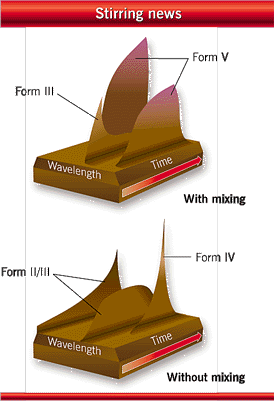
The right structure makes for that melt-in-the-mouth sensation
(繼續閱讀...)
文章標籤

Enzo1985 發表在 痞客邦 留言(0) 人氣(19)

  • 個人分類:Lesson 4: Working with Chocolate - Tempering
▲top
  • 4月 04 週五 201417:32
  • White Paper: Chocolate Tempering

Learning Objective: Understand in more detail what exactly happens during the tempering process


White Paper: Chocolate Tempering
We can never know too much about the chemistry of tempering. Here is an interesting presentation on Chocolate Tempering by Kevin Smith, given at the 2006 Confectionery Manufacturing Expo, Brussels, Belgium.
(繼續閱讀...)
文章標籤

Enzo1985 發表在 痞客邦 留言(0) 人氣(7)

  • 個人分類:Lesson 4: Working with Chocolate - Tempering
▲top
«123...5»

個人資訊

Enzo1985
暱稱:
Enzo1985
分類:
不設分類
好友:
累積中
地區:

熱門文章

  • (93)Lecture: Understanding the History of Chocolate
  • (15)Research: Chocolate Facts and Figures from Peter's Chocolate

文

toggle 第一章 (1)
  • 第一章 (6)
toggle 第二章 Product Knowledge (4)
  • Lesson 1: Product Knowledge (1)
  • Lesson 2: History and Processing (6)
  • Lesson 3: The Chocolate Industry Today (7)
  • Lesson 4: Working with Chocolate - Tempering (7)
toggle 第三章 Introduction (1)
  • Lesson 1: Physiology of Taste (2)
toggle 第四章 Introduction (1)
  • Lesson 1: Technique and Production (3)
toggle 第五章 Introduction (1)
  • Lesson 1: Developing a Plan of Action (4)
toggle 第六章 Continuing Education and Graduating from the Program (1)
  • Graduating from the Program (5)
  • 未分類文章 (1)

最新文章

  • Master Program Update
  • Business Plan for Chocolatiers Program
  • QA Program Registration for Professional Chocolatier Program Graduates
  • CM Program Registration for Professional Chocolatier Program Graduates
  • Graduating from the Program
  • After Program Homework - Understanding the Future of Fine Chocolate
  • Research Assignment 7: Sourcing Your Chocolate, Ingredients and Packaging
  • Business Assignment 6: Creating a Production Plan
  • Information: About Module Five
  • Technique Assignment 5: Recipe Development: Part 2

最新留言

    動態訂閱

    文章精選

    文章搜尋

    誰來我家

    參觀人氣

    • 本日人氣:
    • 累積人氣: